
Car-free travel for families
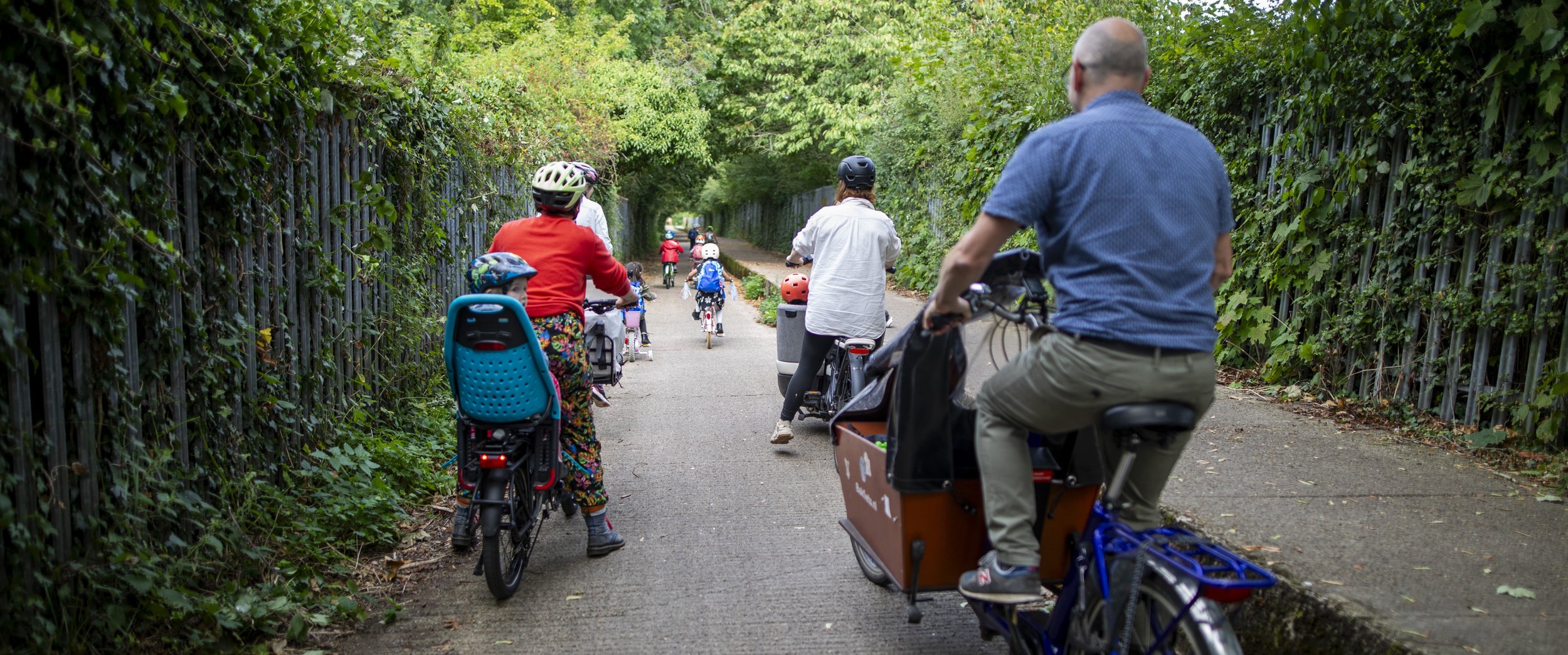
With the school run, football training, music lessons, cubs or scouts, grocery shopping, days out and so much more to consider when you’ve got a young family, it’s easy to assume you’re going to need a car. But as Sarah Edwards found out, plenty of families in Oxford manage to survive and thrive without owning one.
I have been studying for an MSc in Sustainability and Behaviour Change and for my research I was keen to look into the experiences of car free families in the city. This involved undertaking a series of interviews with parents in 10 families across Oxford with children aged between 3 and 16.
Choosing to go car free
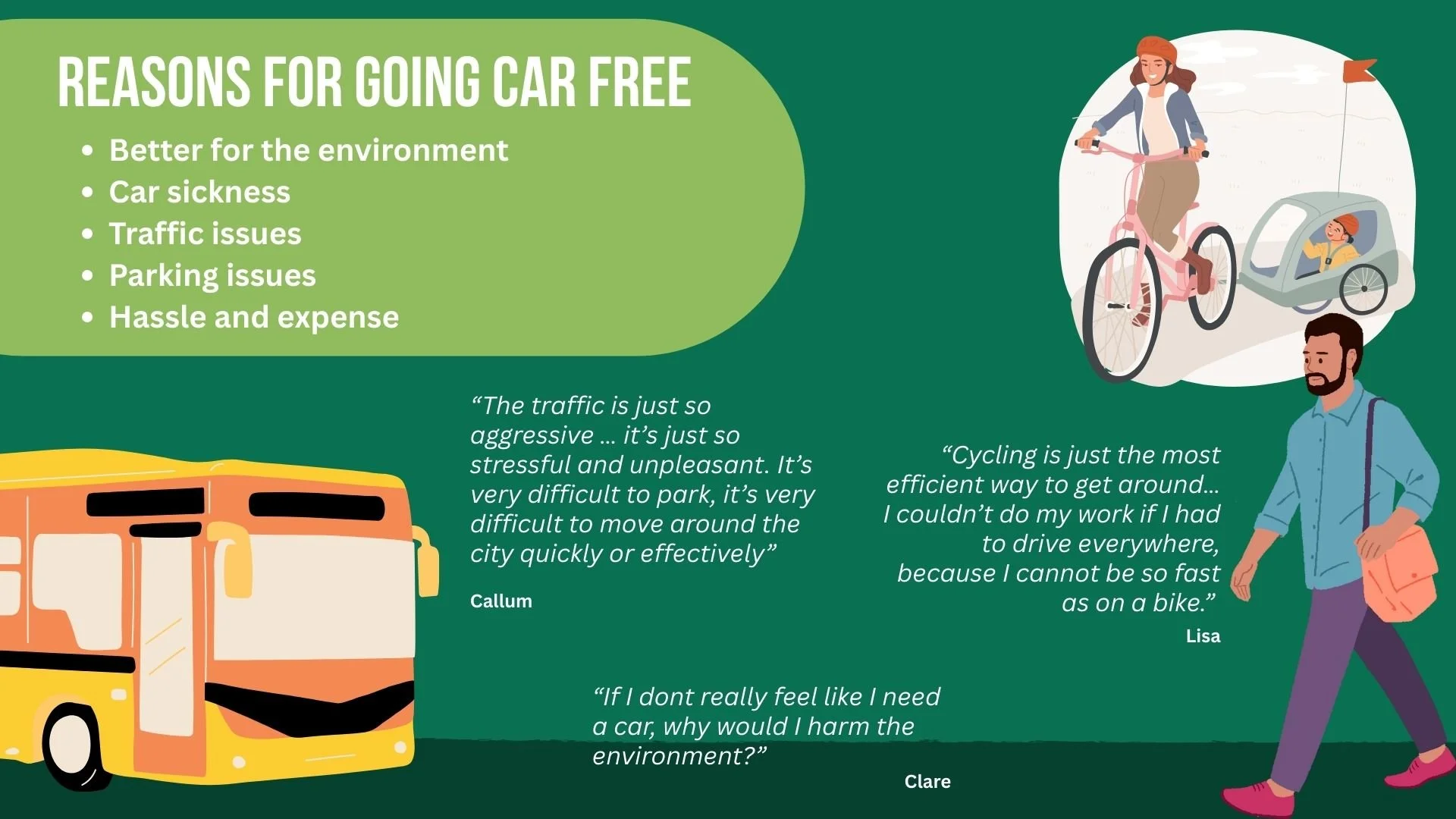
I found there were lots of reasons the parents had chosen to go car free, from concern for the environment to traffic and parking issues, the expense and even car sickness. Everyone I spoke to however, mentioned the benefits of not owning a car, such as the reliability and convenience of arriving at your destination on time if you cycled, the health benefits of active travel and the independence it instilled in children.
Some people were keen to avoid the expense and ‘hassle’ of car ownership, including the stress of unexpected large bills as well as the ongoing running costs. Only two parents said affording a car wouldn’t be an issue, but they did not want one for other reasons.
The benefits of going car free
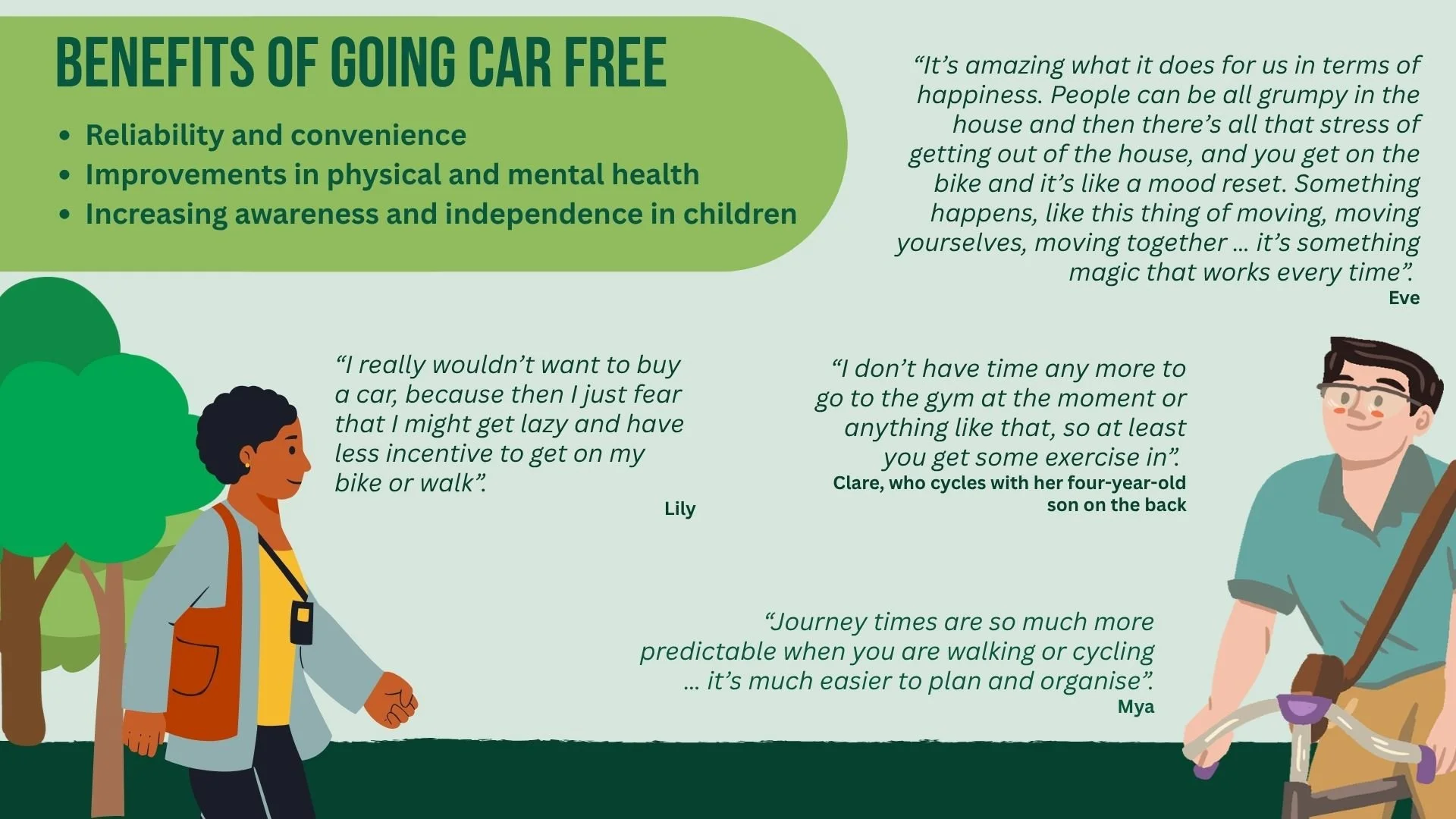
There were many positive reasons why parents preferred to use types of transport other than a car where possible. Cycling and walking were popular with all the families for essential trips, pleasure or both. Parents particularly liked the reliability and convenience of cycling, compared to either a car or public transport in the city. Other benefits mentioned were the physical health gained from exercise and an increase in mental wellbeing.
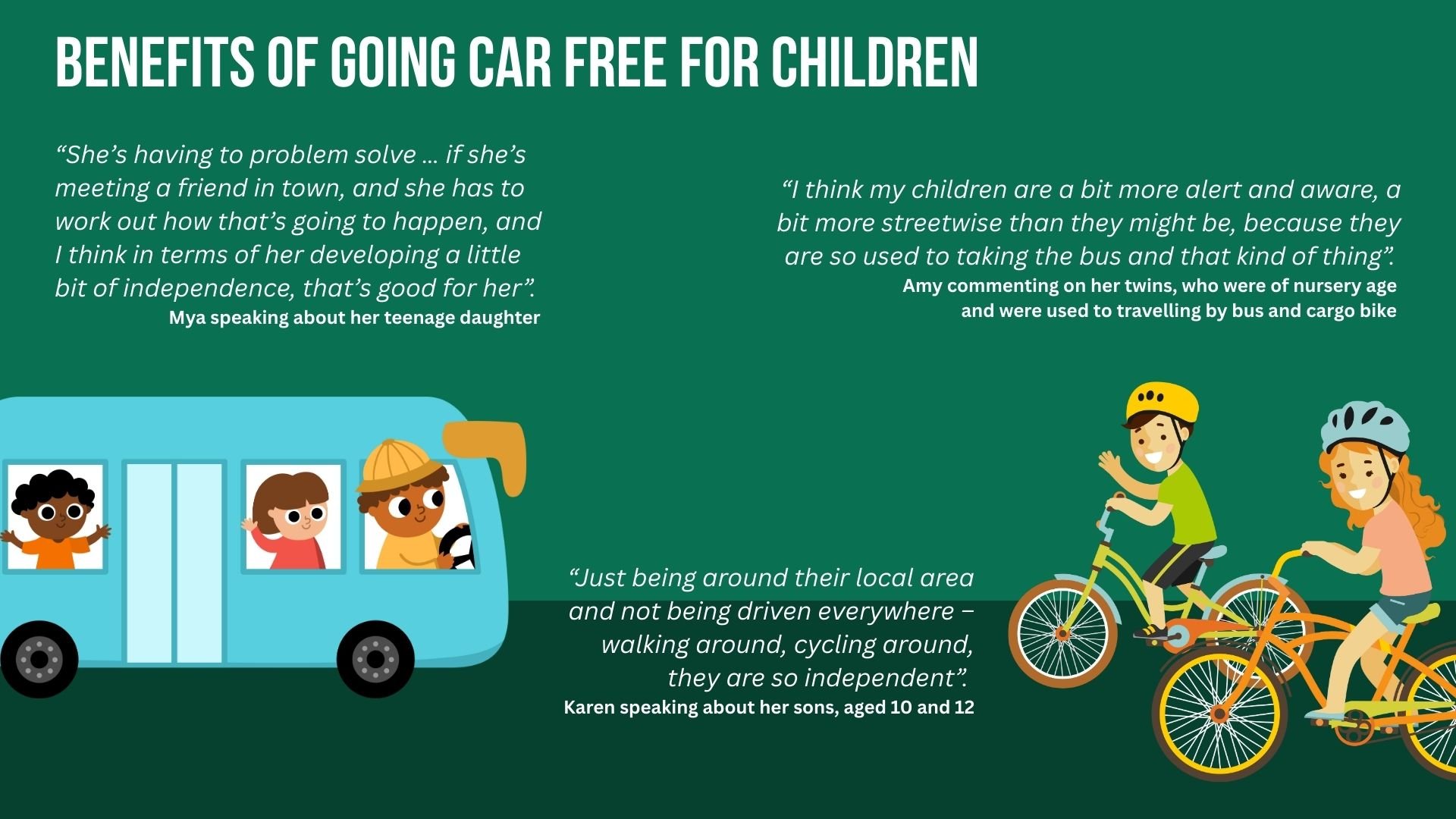
Several parents referred to benefits to the children, for example developing awareness and independence.
Getting to school and work and managing shopping
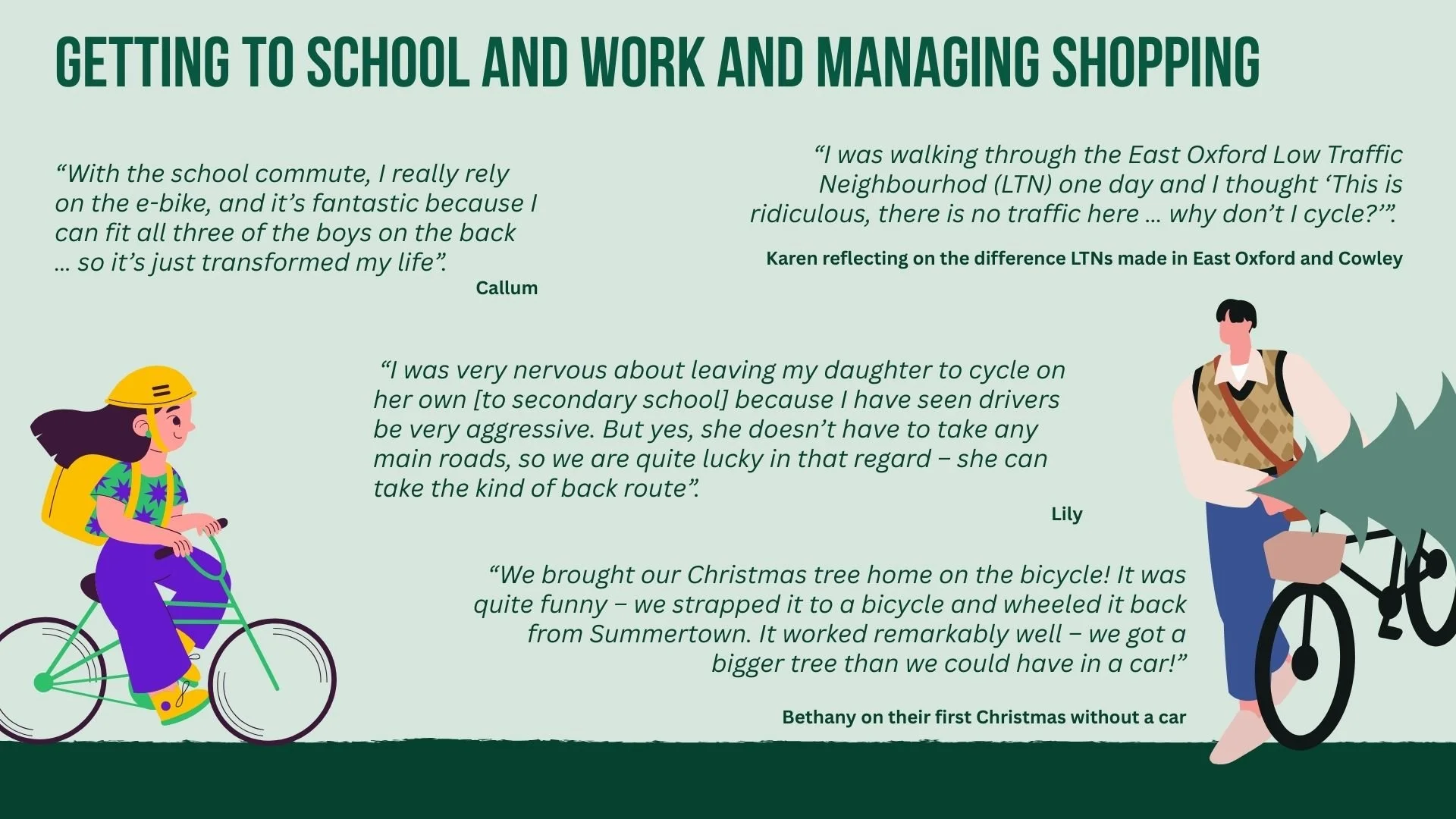
Most of the parents had chosen a home location where they could manage essential trips without a car, and further decisions such as choice of nursery or school were taken with this in mind. The families I interviewed lived in Cowley, Cutteslowe, Donnington, Iffley, Marston, Rose Hill, Sunnymead, Walton Manor and Wolvercote.
For the daily ‘commute’ for children and adults, there was a mix of walking, cycling and bus travel - no-one used a car. Amy’s partner took their twins to nursery on a cargo bike, then continued on to his workplace. The primary school children were either walking, cycling or on the back of a parent’s cycle, while in bad weather they might use a bus.
While most of the primary school age children travelled with a parent or carer, one ten-year-old child walked alone or with friends. Several parents were able to work from home at least part of the week or had some flexibility of work times, which made things easier in terms of escorting young children. One of the single parents had help from her mother, who walked her grandchild to primary school. Callum used a big e-bike to take his three young children to school, and was preparing the eldest to ride his own bike soon. Lisa and Max had offered to accompany some children from other families on the cycling journey to and from primary school and this had become a routine. Knowing that routes were safe enough was a crucial consideration for parents.
For journeys to secondary school, the teenagers travelled alone or with friends, mainly walking or cycling, occasionally by bus. One parent commented on how their child enjoyed walking to school with friends and then playing in the park on the way home.
All but one of the employed parents worked in Oxford, commuting normally on foot or cycle, occasionally by bus. Max commuted 10 miles by bus and reflected that sitting in a car would mean “doing nothing but driving, instead of being on a bus and maybe reading a book or working”.
For most of the families, shopping included a home delivery of groceries, topped up by small-scale purchases by bike or on foot. One family walked to a nearby supermarket and the children sometimes helped carry shopping home. Eve used a cargo bike for their weekly shop. Leila entered into a regular lift share with someone in her neighbourhood who had a car. They went shopping together and Leila contributed towards the fuel and commented on how nice it was to have that regular chat on the shopping trip. Some families surprised themselves as to what they could transport on a bike.
Beyond the daily routine
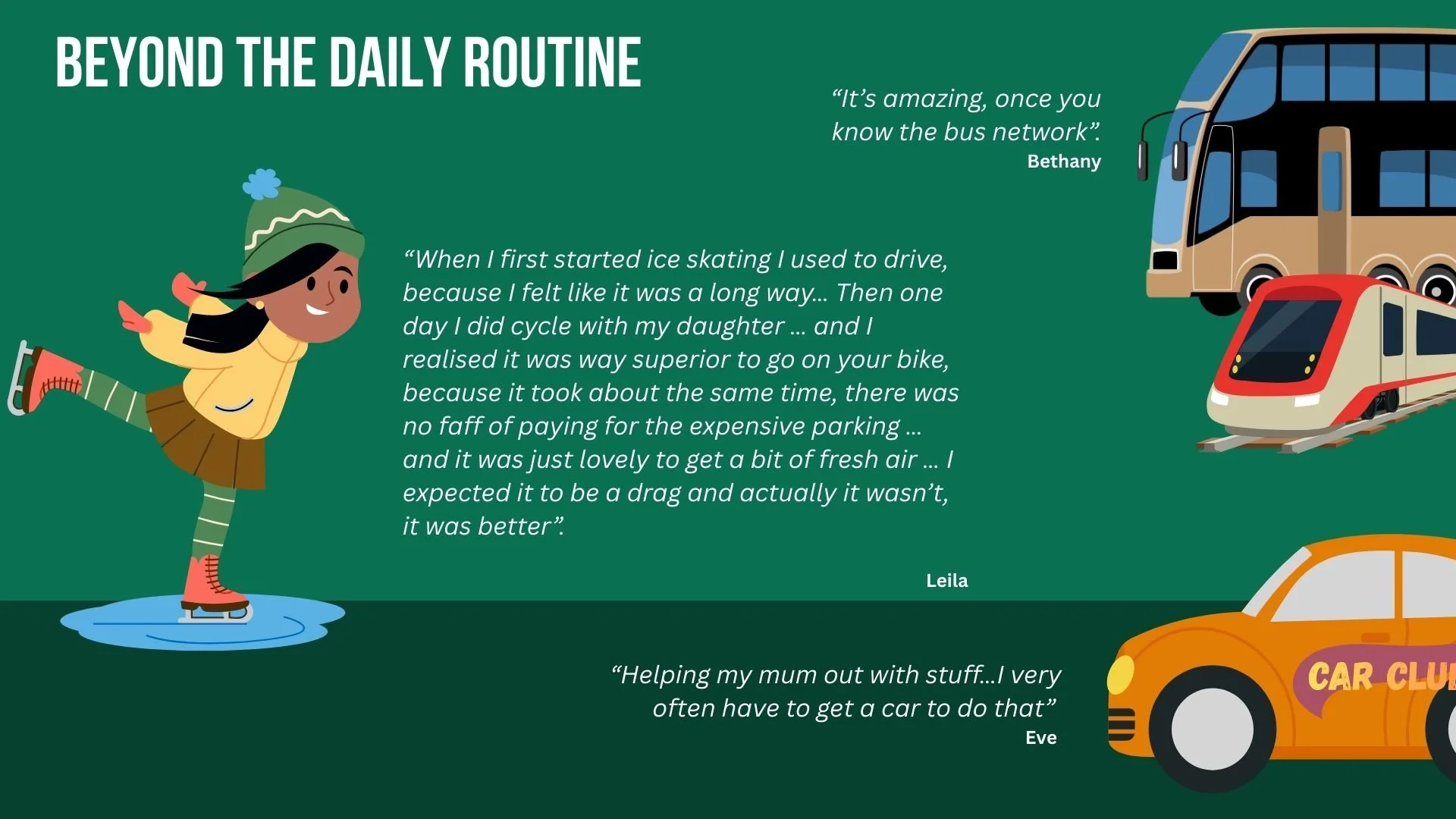
While parents found that the daily essential journeys were fairly easily achieved without a car, there were times when other journeys were less straightforward, for example because of distance and/or inadequate public transport. For after- school, social and recreational activities, one approach was to focus on ‘staying local’ as much as possible. For example, choices about which clubs to participate in would be made bearing in mind their accessibility without a car. For taking kit to sports events, Eve would use a cargo bike, while the children cycled.
There were many examples given of trips out by bike, bus or train. Blenheim Palace, with its annual entrance ticket was one popular destination, and Sean explained that his family had worked out several ways to reach the Chilterns by public transport. Clare’s family enjoyed visits to the coast, by taking the train to Bournemouth.
For journeys that were more difficult without a car, some parents made use of a car club or the ‘Hiyacar’ scheme or had an arrangement to borrow a car e.g. from a neighbour or grandparent. Sharing lifts, and where possible returning the favour with a club car, was one approach. When meeting up with friends, parents mentioned negotiating a mutually convenient location, and sometimes used taxis to reach places not well served by public transport.
Care and support, e.g. for a grandparent, was a situation where a car was more likely to be needed, and examples were given of how this help was arranged. In some cases, the grandparent’s own car was available.
Making life easier
Finally, I spoke to parents about what they thought needed to change to make things easier for them and others who do not own a car. Parents had many suggestions, including making cycling conditions much safer, improving bus services and making them more affordable, and ensuring car clubs were available in all areas. There was a general concern that travelling by car was seen as the ‘default’ solution to travel, from planning infrastructure and organising events to society’s attitudes, and that this definitely needed to change.
Pseudonyms were used to maintain anonymity of participants.
We’d love to hear about your car-free travel tips. Get in touch at info@oxfordtraveloptions.co.uk.
Tips for car-free travel
You’ll find loads of information about car-free travel on Oxford Travel Options.
Check out the links below for information on:
Find out how 12 Oxford drivers got on when they tried going car free for three weeks.